Tattoo schooling for serious beginners and working artists

Whiskey Bent & Hell Bound Tattoo Schooling

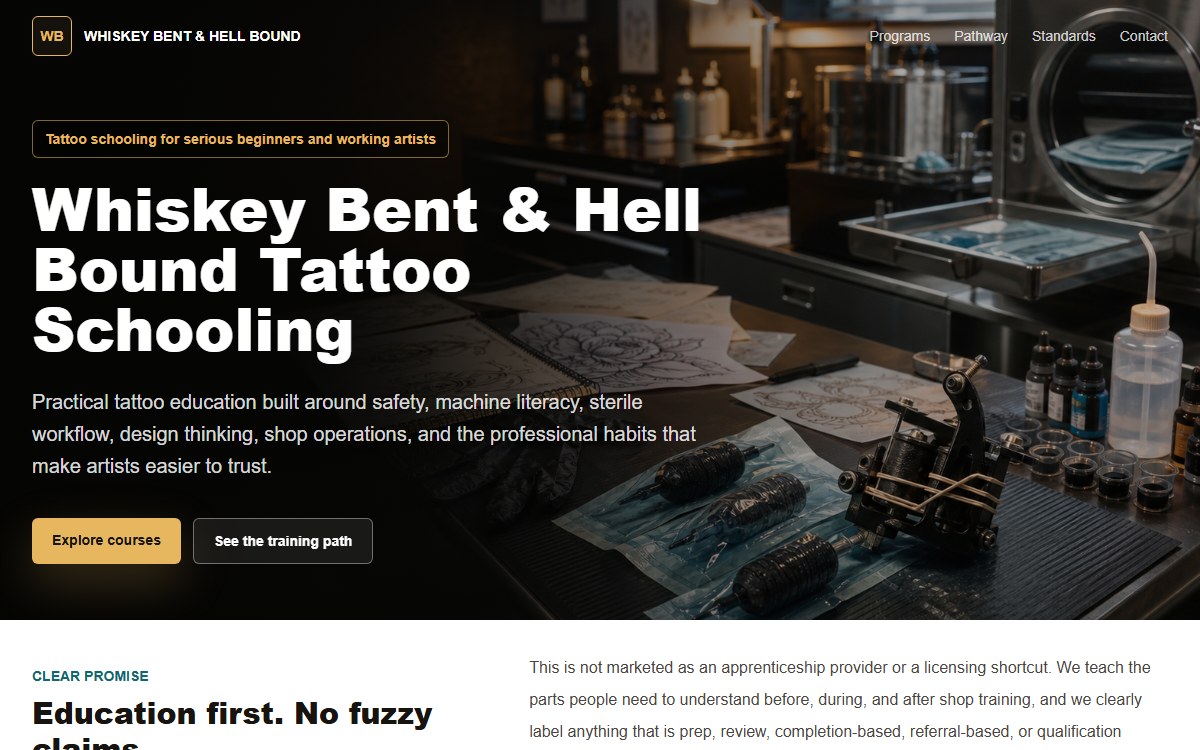
Practical tattoo education built around safety, machine literacy, sterile workflow, design thinking, shop operations, and the professional habits that make artists easier to trust.

Education first. No fuzzy claims.

This is not marketed as an apprenticeship provider or a licensing shortcut. We teach the parts people need to understand before, during, and after shop training, and we clearly label anything that is prep, review, completion-based, referral-based, or qualification specific.

Curious but not ready for a full apprenticeship

Explore tattooing responsibly before committing your schedule, finances, and reputation to the wrong next step.

Existing artists continuing education

Refresh safety, systems, business, stencil, consultation, or machine fundamentals without starting over from square one.

Learn the craft around the chair, not only in it.

Workshops and course tracks focus on the systems shops care about: clean setup, prepared artists, sound design, informed consultations, and documentation habits.

Focused skills

Weekend Workshops

Short-format classes for artists who want a practical tune-up on sterilization, machine care, stencils, consultation, or aftercare.

Before the chair

Beginner Tattoo Theory

A grounded starting point for curious beginners who want to understand tools, safety, design, and shop culture before seeking an apprenticeship.

Career systems

Tattoo Business Boot Camps

Booking, pricing, client communication, portfolio presentation, marketing rhythm, and the operating habits behind a sustainable practice.

Compliance prep

Sterilization Certification Prep

Prep support for infection-control concepts, autoclave vocabulary, logs, barrier methods, and local requirement research.

Critique path

Portfolio Review Programs

Structured feedback for apprentices, self-taught artists, and career changers who need sharper presentation before shop conversations.

Orientation

Introduction to Tattooing

A broad overview of the craft, responsibility, shop expectations, design thinking, and what to prepare before pursuing deeper training.

Built for safe rooms and better habits.

The core curriculum teaches tattooing as a complete shop responsibility: technical setup, sterile process, client care, visual decision-making, and business judgment.

Machine setup and maintenance

Coil and rotary fundamentals, grip and needle setup, troubleshooting habits, and clean teardown routines.

Bloodborne pathogens and infection control

Barrier thinking, exposure control language, PPE habits, cross-contamination prevention, and shop-ready safety drills.

Sterilization and autoclave training

Instrument flow, packaging, logs, spore-test awareness, and how to keep sterile processes understandable.

Shop operations and compliance

Daily room resets, release forms, supply discipline, local-rule research, and the records shops expect artists to respect.

Tattoo design fundamentals

Line weight, contrast, flow, scale, placement, longevity, and how to translate an idea into tattooable artwork.

Stencil creation

Digital and hand-drawn stencil prep, sizing, readability, skin placement, and transfer best practices.

Skin anatomy theory

Skin layers, stretch, healing behavior, client variables, and why theory matters before touching a machine.

Client consultation skills

Scope, consent, expectation setting, reference review, revision boundaries, and professional communication.

Portfolio development

Curation, critique, style direction, page sequencing, shop-visit preparation, and artist statement polish.

Business and marketing for artists

Pricing language, booking flow, social proof, content rhythm, client retention, and building a reputation carefully.

Piercing jewelry education

Jewelry materials, sizing language, aftercare conversations, display basics, and safe referral boundaries.

Aftercare protocols

Plain-language healing instructions, red-flag escalation, documentation, and consistent client follow-up.

School to advanced workshops to referral network.

The pathway is built to help people move responsibly: learn the fundamentals, keep sharpening, then pursue shop conversations when the work and mindset are ready.

1School

Build the baseline

Start with safety, design theory, tools, skin anatomy, and professional habits. Learn the language before you ask a shop to invest in you.

2Advanced Workshops

Sharpen the edges

Return for focused sessions in sterilization, machine maintenance, portfolio critique, business systems, and shop operations.

3Shop Apprenticeship Referral Network

Meet the right rooms

When a student is ready, we can help make introductions to participating shops. Referrals are based on fit, readiness, and shop availability.

Say the responsible thing plainly.

The site is written to attract the right people while protecting the brand from overpromising. Use course pages to specify exact prerequisites, completion records, or certification details.

Courses are educational unless a specific offering states otherwise.
No program is presented as state-recognized licensure unless it actually qualifies.
Referral support is not an apprenticeship placement guarantee.
Students should confirm city, county, and state requirements before relying on any training for compliance.

Start with the class that matches your risk level.

Not sure whether to take intro theory, a weekend workshop, or a portfolio review? Start with a syllabus request and we will point you toward the track that fits your current experience.

Request a syllabus